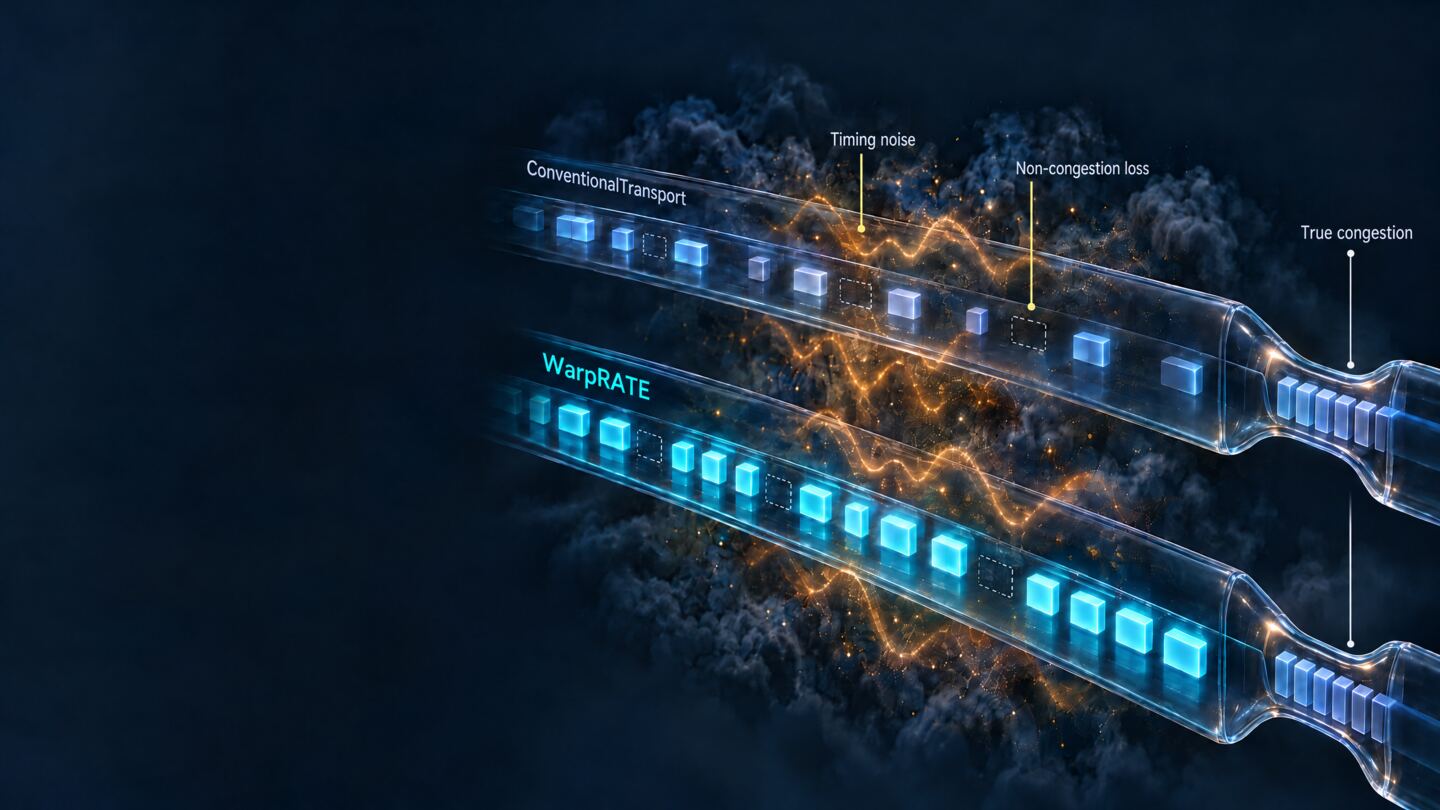
Unlock Your Network's Full Potential With WarpEngine™

WarpEngine powered by WarpRATE™ boosts throughput 2–3× in typical deployments and 20× or more under high jitter and loss.

Step 1

Jitter Now Dominates Packet Transmission Time

As networks get faster, packet serialization time falls by orders of magnitude. Jitter does not: it holds roughly constant on wired hardware and is growing with wireless, virtualization and satellite links. That widening gap invalidates the ACK timing signals traditional congestion control uses to set TCP sending rates.

  • At high speeds, timing noise overwhelms the real signal: at 10 Gbps, jitter can be hundreds of times the time to send a packet.
  • Packet loss and the jitter added by network topology (wireless hops, virtual switches, satellite links) widen the gap further.
  • Jitter, not congestion, now dominates the ACK timing that CUBIC and BBR use to pace TCP.
Faster Links, Same Jitter
Faster Links, Same Jitter Grouped bar chart on a logarithmic time scale. Serialization time for a 1500-byte packet falls a thousandfold as link speed rises from 10 Mbps to 10 Gbps — 1.2 ms, 120 µs, 12 µs, 1.2 µs — while network jitter stays at about 0.5 ms. At 10 Mbps jitter is smaller than the packet time; at 10 Gbps it is about 400 times larger. 0.1 µs 1 µs 10 µs 100 µs 1 ms 10 ms Time (log scale) 1.2 ms 500 µs 120 µs 500 µs 12 µs 500 µs 1.2 µs 500 µs 10 Mbps 100 Mbps 1 Gbps 10 Gbps
  • Serialization time (1500-byte packet)
  • Network jitter

Jitter shown at a typical 0.5 ms; wireless, virtualized and satellite paths often run higher.

Faster Links, Same Jitter
Link speed Serialization time (1500-byte packet)Network jitter
10 Mbps 1.2 ms500 µs
100 Mbps 120 µs500 µs
1 Gbps 12 µs500 µs
10 Gbps 1.2 µs500 µs
Step 2

Why Other Network Optimization Solutions Fall Short.

Congestion control operates at the transport layer — most optimization solutions don't.

  • Bandwidth upgrades add physical layer capacity, but ignore jitter and loss-driven transport layer TCP control stalls.

  • QoS and prioritization improve selected traffic flows while suppressing others, thereby contributing to timing variability and inducing stalls.

  • SD-WAN and SASE reroute traffic based on network endpoint conditions, but have no impact beyond them.

  • AI networking makes real-time routing and configuration changes that can add timing variability.

  • Jitter buffers reorder packets and realign packet timing at the application layer, thereby injecting timing variability and inducing stalls.

  • TCP parameter tuning typically delivers only 1–5% gains because it does not change congestion control's response to jitter and loss.

  • Deduplication and compression provide no benefit as virtually all traffic is encrypted, compressed or both.

Step 3

WarpEngine Addresses the Problem Where it Occurs.

Patent-pending WarpRATE rebuilds congestion control at the transport layer. It separates the three jobs conventional algorithms tangle together (send-rate pacing, in-flight data control and loss detection), so a timing hiccup in one no longer throttles the others. WarpRATE also adds per-flow fairness at the queue, so no single flow crowds out the others.

  • RATE

    Anchors traffic pacing to NIC wire speed — not noisy ACK cadence.

  • ALLOW

    Sizes in-flight data to measured path capacity.

  • LOSST

    Uses jitter-aware timing to avoid false loss decisions.

  • PFQD™

    Adds simple per-flow fairness at the queueing layer.

The result is transport that is insensitive to the jitter and loss that impair typical networks. Flows run at the highest rate the path can deliver, without inducing heavy packet loss or buffer overflows.

What WarpEngine With WarpRATE Looks Like On The Wire

Throughput over time: conventional transport collapses once jitter and loss begin; with WarpEngine it stays close to physical capacity. time → throughput Physical capacity jitter & loss begin conventional transport with WarpEngine™ recovered throughput
Illustrative — shape, not a measured trace.

Same link, same physical capacity. Once jitter and non-congestion loss begin, conventional transport backs off on every timing hiccup; WarpEngine™ with WarpRATE identifies noise from congestion and holds throughput close to capacity.

The shaded gap represents throughput that you already paid for and are leaving on the table.

Timing noise ≠ network congestion

What WarpEngine delivers in deployment

  • Simple Deployment

    Quick deployment via either physical hardware or virtualized container.

  • Up to 20X+ Throughput Gains

    vs. CUBIC/BBR under high jitter and packet loss

  • Single-Ended, Transparent

    Physical or Virtual. Benefits entire network. No changes to existing infrastructure or hardware required.